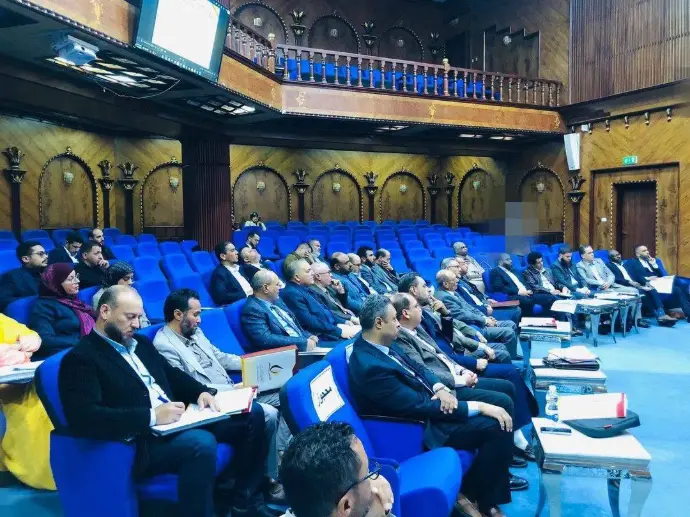
Active participation of the Faculty of Law at Nalut University in the initiative launched by the School of Legal Sciences to save the unity of the judiciary in Libya
Janzour | April 18, 2026
Where each of the following participated:
- Dr. Mohammed Dou Abu Khreis.
- Mr. Omar Rajab Al-Mahrouq.
And the branch of the college in Al-Ruhaybat was present:
- Dr. Sami Al-Farjani.
- Dr. Mohamed Abdelsayed
Furthermore, the attendees enriched the topics of this initiative with great competence, as the intervention of Mr. Omar Rajab Al-Mahrouq, the Deputy for Academic Affairs at the college, was delivered as follows:
In the name of Allah, all praise is due to Allah, and peace and blessings be upon the Messenger of Allah. Before delving into the details of the initiative, allow me to first point out an important issue related to the organizational process of the forum, which is the absence of academic presence from the eastern region of our beloved Libya. I am inquiring whether this absence is related to organizational matters or other issues, as such a lack in presenting this initiative will lead to it being one-sided instead of being three-dimensional, according to the well-known historical geographical distribution of the Libyan state.
Secondly: Regarding the third pillar of the initiative related to the proposed transitional phase, we believe that Libyans have developed a "phobia" of transitional phases. If we were to liken it, we might compare it to the issue of committees formed in the public sector to resolve problems, which ultimately leads to solutions being lost and a continued state of chaos. The evidence is that we have been in transitional phases for more than 15 years.
Thirdly: The rapporteur of the dialogue session pointed out that the issue cannot be separated from the political aspect, which necessitates that we have a higher framework to guide and drive us as professionals and legal experts. This involves a serious and professional push towards the necessity of returning to complete the constitutional path to serve as a starting point, especially since our fruitful dialogue is under the slogan (Towards a Unified Judiciary and the Rule of Law). This rule of law can only be achieved through its most important legal document, which is the constitution, from which we can launch.
Fourth: For this initiative to be effective, it must clearly ensure mechanisms and real guarantees that lead to not returning to division and fragmentation in the future.
In summary, we legal professionals are at a pivotal stage where we can either be protectors of legitimacy or witnesses to its collapse. We can either contribute to building and restoring the state through the law, or through our silence and perhaps our bias, we may contribute to deepening the existing problem. Thank you.
This initiative comes within the framework of scientific and national roles, announced by the School of Legal Sciences at the Libyan Academy of Graduate Studies, to launch a national initiative aimed at saving the unity of the judiciary in Libya and enhancing its independence, in light of the current challenges facing the judicial system.
The forum witnessed a significant presence of representatives from law faculties and faculty members from various Libyan cities, including the law faculties of the universities of Tripoli, Zawiya, Zuwara, Sabratha, Sorman, Zliten, Nalut, Al-Ruhaybat, Zintan, Gharian, Misrata, Zliten, Al-Margab, Bani Walid, Wadi Al-Shati, Sabha, Fezzan, Al-Zaytuna, Gulf of Sidra, and Sirte, reflecting a broad national academic consensus on the importance of maintaining the unity of the judiciary.
This initiative stems from a deep understanding of the seriousness of the phase that the Libyan state is going through, and the unprecedented developments affecting the structure and unity of the judiciary, considering that the judiciary is the fundamental pillar of the rule of law and the last guarantor of its stability.
The initiative aims to:
- Maintaining the unity of the judiciary and preventing any internal division
- Empowering the judiciary to address its crisis from within the institution itself
- Preparing for a consensual and sustainable legal reform
The initiative is also based on a number of key pillars, the most prominent of which are:
- Maintaining the judicial reference of the Supreme Court
- Strengthening the independence of the Public Prosecution
- Establishment of a transitional higher judicial authority based on seniority.
- Preparation of a consensual legal treatment for the judicial crisis
The School of Legal Sciences confirmed that this initiative aligns with the vision of the Libyan Academy for Graduate Studies in enhancing its national role, actively contributing to the support of state institutions, and reinforcing the principles of the rule of law.
Participants also emphasized the importance of the role played by academic institutions in providing robust legal solutions that contribute to supporting the unity of the state and its institutions, and enhance the status of academia as a leading scientific institution in serving the community and decision-making.
The forum concluded by emphasizing that the unity of the judiciary is a fundamental condition for the stability of the state, and that maintaining it is a shared national responsibility that cannot be postponed.